Space Shooter is a Unity space-combat experiment built around one question: can the simple act of piloting a ship carry an entire roguelike? I want accelerating, drifting, turning, strafing and boosting out of danger to feel satisfying before adding a mountain of content.
The direction is an incremental roguelike: fight for experience, shape a temporary build during each attempt, then take earned credits back to the hangar for permanent improvements. The aim is to make every run teach a flying lesson and move the ship forward, while keeping a well-flown starting ship capable of winning.
Read the attack. Choose your response.
Enemies generally move slowly, but their attacks ask different questions. A Gunner commits to a firing lane. A Fanner spreads three shots across an angle. A Bombardier marks a position before bullets erupt outward. Warnings and gaps give momentum a purpose: change course, create space or commit to a risky opening.
The turret aims and fires automatically by default, with priority for active bosses in range. That leaves attention available for flying. Manual aiming is an option in the hangar for players who want direct control.
Two kinds of progress
Experience produces choices that last for the current run. Credits fund a hangar split into Turret, Ship and Research. Turret upgrades improve one weapon; small ship-wide bonuses support the whole loadout; research unlocks larger steps such as the Double turret, repair drones and upgrade rerolls.
Research also controls the level-up pool. A system must be unlocked before its improvements can appear, and weapon-specific cards follow the equipped turret. Permanent gains should feel worthwhile without turning dodging into an optional extra.
What is playable now
The browser prototype has one bounded test area, spawning enemies, temporary upgrades, an optional stationary Sentinel, a timed pursuing boss, results and a return to the hangar. A new game waits for the first movement input; loading saved progress opens the hangar. Browser saves stay in that browser.
This is a compact proof of the loop. The longer-term target is a 15–20-minute area with two to four optional minibosses and around five major bosses arriving over time. That full sequence, more distinctive boss artwork and a broader weapon roster are still development goals.
What I want to learn next
Does dodging stay interesting as attacks overlap? Are optional fights worth their risk? Do upgrades create useful choices, and does a failed attempt make another launch appealing? Those are the questions guiding the next playtests. The numbers, artwork and interface will keep changing as the answers become clearer.
Prototype note Early desktop prototype. Progress is saved in this browser; clearing site data can erase it.
02 // WORK IN PROGRESS
Dev Logs
Notes from the workshop. Changes, discoveries, and the next build.
Dev log 002 — More space, clearer boundaries and easier decisions
With the first gameplay loop in place, the next pass has been about giving the ship more room and making the game easier to read. The flying is still the center of the experiment: this update changes the space around the player, how optional minibosses respond to a retreat, and how clearly the interface explains an upgrade.
This is a follow-up to the launch catch-up, covering the arena and UI work together. The screenshots are genuine Unity verification captures. Encounter scenes use controlled setups, and upgrade screens may show a funded test save rather than normal progression.
01 / A bigger mission area, with an edge you can understand
The arena radius has increased from 24 to 48 world units. That doubles its width and gives it four times the playable area. Enemy spawning still stays inside the mission area, while the extra room makes a longer flight or a change of direction feel less cramped.
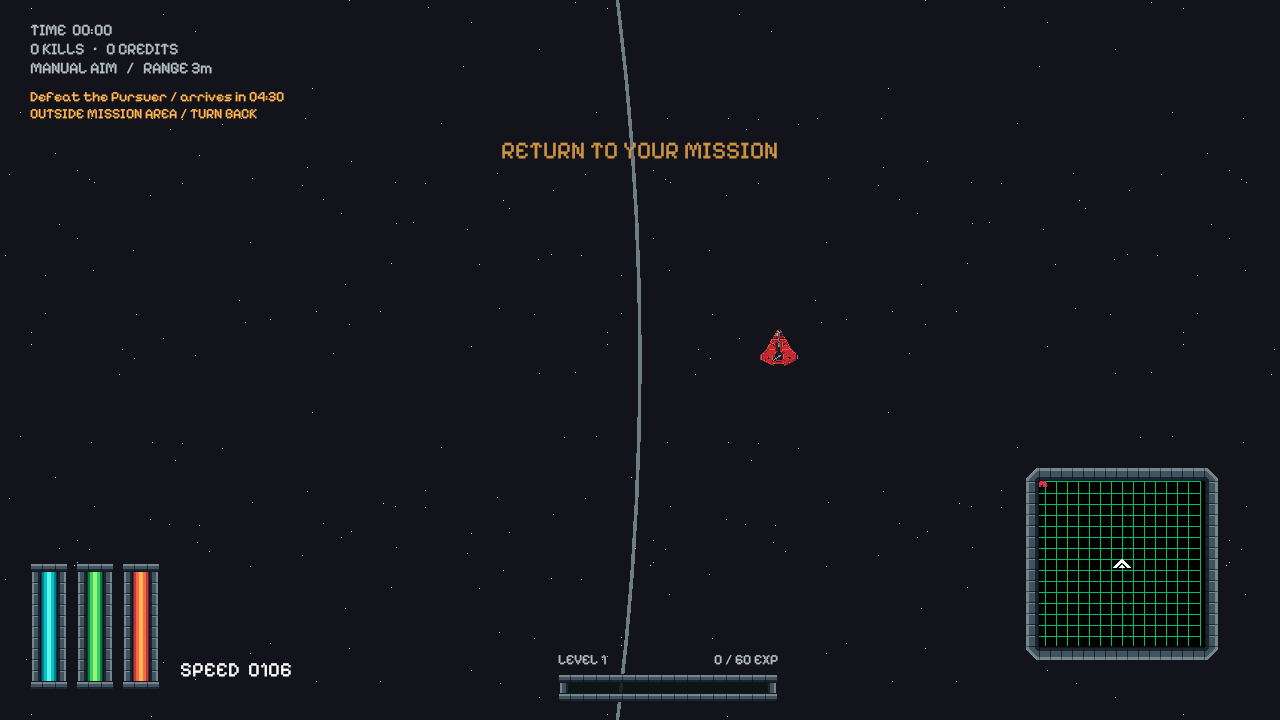
There is now a visible outline around the mission area. Previously, the boundary started influencing movement before the player had a clear visual line to cross. The new behavior leaves flight alone inside the outline. Crossing it brings up a flashing Return to your mission warning and gradually adds inward pressure while damping outward speed. Movement along the edge stays available, and the ship is not teleported back into the arena.
That distinction matters for a game built around momentum. The player should be able to see why their ship is being pushed back, and should have a chance to turn that warning into a deliberate course correction.
Boundary verification from the arena pass, before the font change: return pressure begins outside the visible outline.
02 / Minibosses defend a home instead of standing still
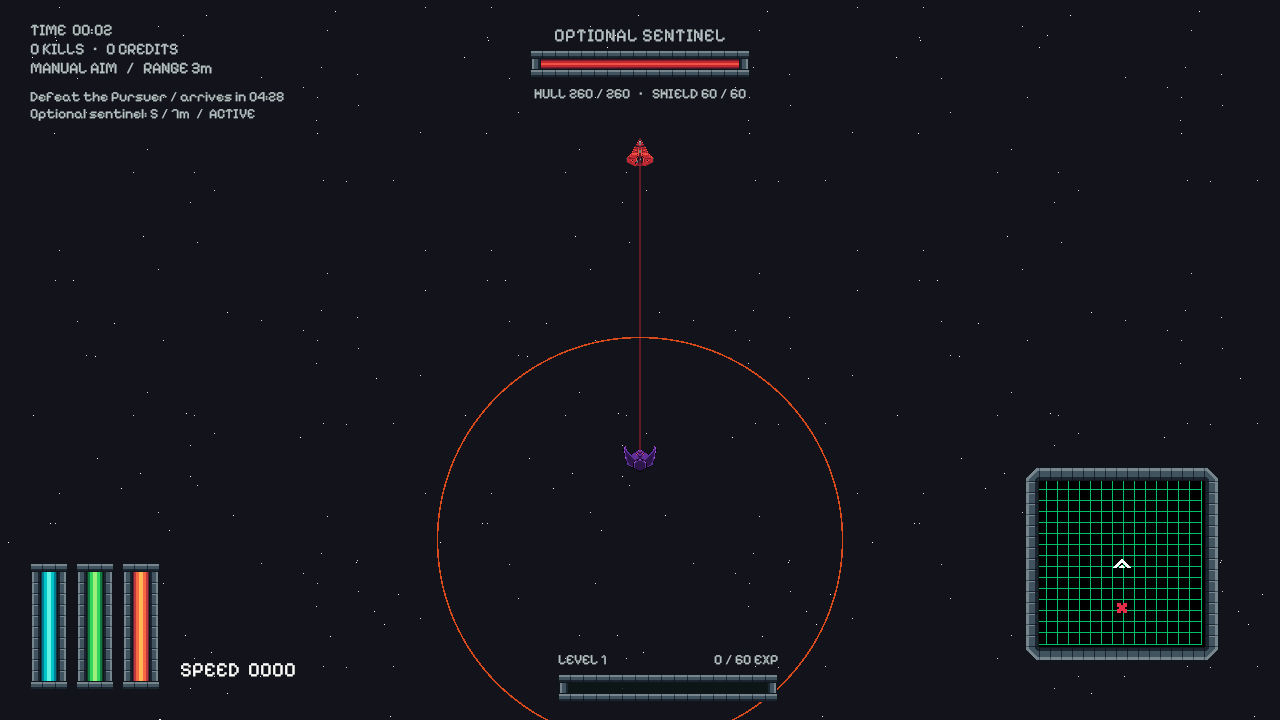
The optional sentinel now follows the player after they enter its initial area or attack it. The pursuit has a limit: twice the initial activation radius, measured from the original home position. In the current tuning, that means a 4.5-unit activation radius and a nine-unit leash.
If the player or sentinel moves beyond that leash, the sentinel cancels its pending attack and returns home. It cannot be pulled out of that return by another hit. Once home it becomes dormant again and can be re-engaged. Hull damage persists, and normal shield recovery still applies, so retreat is possible without turning the encounter into a completely fresh boss every time.
The home position has also moved farther into the larger arena. Placement now reserves enough room for the entire chase radius plus a flight lane before the mission boundary. The marked activation circle stays at home, and the HUD identifies when the sentinel is returning.
Controlled pursuit test from the arena pass. The activation circle stays anchored to the sentinel's home while it follows within its leash.
03 / A smaller Bombardier warning
The Bombardier's animated warning circle has been reduced by another 50 percent, from a diameter of 0.8 to 0.4 world units. It still marks the committed origin of the eruption rather than an instant-damage area. The eight outward projectiles and their existing warning timing are unchanged.
The aim is to make the marker proportionate to what it means: leave this point before the bullets erupt, then navigate the gaps. The earlier, larger circle made the danger look broader than the actual origin.
04 / Less tinting, more readable choices
The menus and hangar now use smaller rounded buttons and a darker charcoal-to-slate palette taken from the supplied artwork palette. Muted grey text, a restrained mint accent and amber warnings sit alongside the existing pixel-art frames. The hangar uses a solid background so the combat HUD does not show through it.
Jersey 15 replaces the previous interface font across the HUD, menus and upgrade screens. Numbers are a large part of this game: damage, firing rate, range, hull, credits and the before-and-after values on upgrade cards. Readability there is more useful than adding decoration.
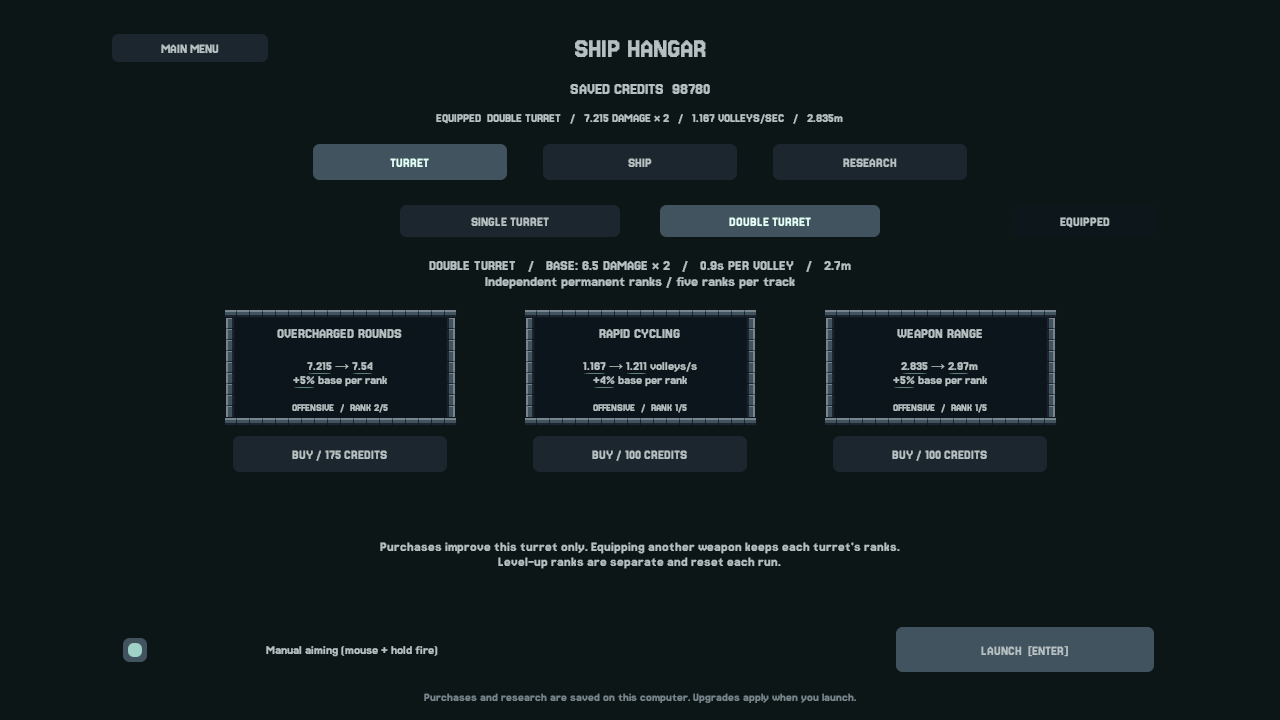
Upgrade values now have subtle underlines to help separate the numbers and percentage changes from the explanation around them. Level-up cards keep their artwork colors when hovered; an outline shows which card is under the pointer instead. Buttons use the same mint border for hover and keyboard focus, and disabled controls do not advertise themselves as available choices.
These are presentation changes. They do not change upgrade prices, rank caps, research requirements or the distinction between permanent hangar progression and temporary run upgrades.
Jersey 15 and underlined before-and-after values in the hangar. This verification save has deliberately generous credits.The first card is shown in its hover state: a thin mint border, unchanged artwork colors and underlined upgrade values.
05 / What this pass is testing
The arena checks cover unchanged flight inside the boundary, return pressure outside it, safe miniboss placement, real pursuit, cancellation at the leash and a return home without restoring hull. The existing combat checks also exercised Bombardier timing, enemy attack patterns and automatic targeting. The interface pass adds checks for the new font and border behavior, alongside the hangar's research, equipment and upgrade rules.
The next useful feedback is practical: does the larger area still feel active, does the sentinel offer enough room for a satisfying chase, and can an upgrade be understood quickly while the action is paused? The full 15–20 minute mode with several minibosses and multiple major bosses remains the longer-term target; the current prototype is still the compact first-loop test.
Dev log 001 — From a flying ship to the first gameplay loop
Rude Valley has just gone live, so this first dev log is a fairly big catch-up. Space Shooter already has a history behind it: early Unity work recorded in August, ship and interface artwork iterations, a break, and then a much clearer idea of the game I want to make. Rather than pretend this is day one, I want to record how those pieces became the prototype you can now play here.
The thread running through it all is the ship. I like movement with a little weight: applying thrust, carrying momentum, turning, strafing and using the afterburner to escape something that looked safe a moment ago. The challenge has been finding a game loop that makes that movement matter.
The early history below comes from the project notes and Git history. The images are genuine saved gameplay and verification captures, not a complete dated archive of every build. Some show controlled test encounters, older layouts or deliberately generous test wallets.
01 / Before the roguelike: make the ship worth flying
The first foundation was a ship moving through a starfield, with a camera, layered backgrounds and a turret. Forward and reverse thrust, rotation, sideways movement and afterburner control gave it several ways to respond. I wanted space for deliberate course changes rather than movement that instantly snaps to a direction.
The early combat work turned that foundation into a test station: spawn an enemy, exchange shots, take damage and try again. Hull and shields became separate resources, shield recovery introduced a reason to make space, and death and restart made encounters repeatable. Camera work, health displays and radar helped make the scene understandable while moving.
There was no need for a large game mode yet. The immediate question was whether flying and fighting could feel good enough to build on.
02 / Let the artwork explain what the ship is doing
Ship, turret, shield, thruster and afterburner sprites gave the mechanics a more coherent pixel-art identity. Firing animations and projectile origins had to line up with the barrels, and the shield needed to sit around the hull correctly while the ship and turret turned independently.
The artwork integration also brought laser impacts, destruction effects and visible hull damage. Damage marks respond to lost hull rather than shield hits, so a battered ship tells a different story from one that has only lost its protective bubble. The HUD began to show hull, shields, boost reserve, speed and nearby threats in the same visual language.
These were small tasks individually, but they made the controls and damage system easier to read. A thrust input should look like thrust; a hit should feel as though it landed somewhere on the ship.
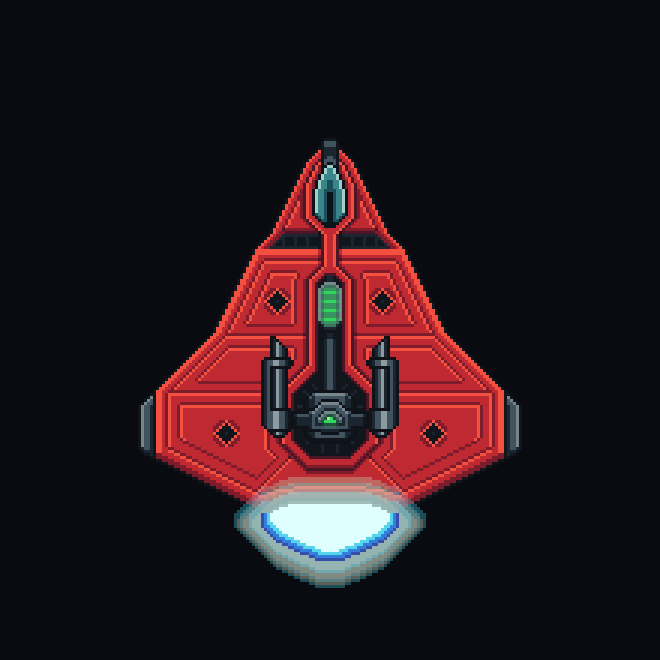
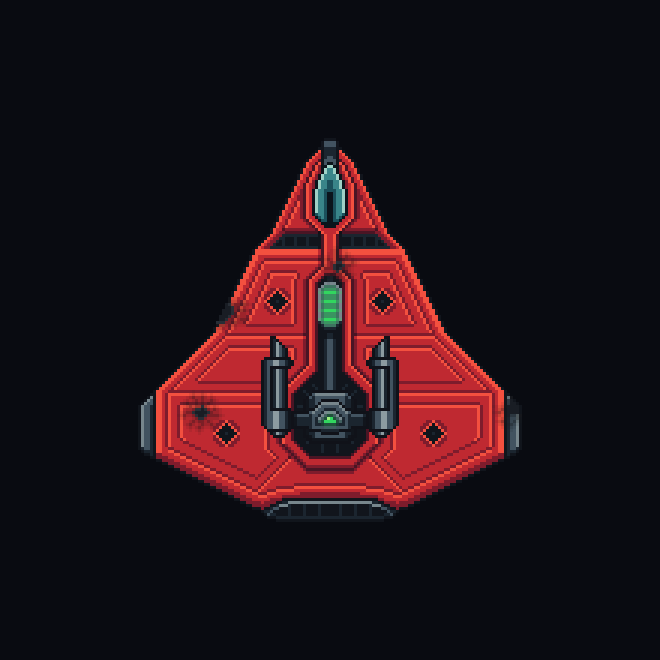
Artwork verification: the player ship with its afterburner active. The twin turret shown here predates the decision to start with Single.Hull-damage verification: impact marks make damage visible on the ship itself.
03 / Returning with a clearer direction
After a break, adding more small improvements was no longer enough on its own. I wanted to find out whether there was a proper gameplay idea underneath the movement. Writing a living design document gave the project a first mode to work towards: an incremental roguelike in a larger combat area.
The intended loop became fly, dodge, destroy enemies, gain experience, choose temporary upgrades, take on bosses, then return to the hangar with credits. A longer successful area should eventually take roughly 15–20 minutes. Permanent progression should provide noticeable but capped help, with piloting still central.
That document also helped separate ambition from the next useful build. Instead of immediately making a full map and five major bosses, the first milestone was one small but complete version of the loop.
04 / Give the player an attack they can actually dodge
The first focused encounter used a Gunner with a warning, a committed firing direction and a recovery window. Once the attack is committed, the enemy does not keep perfectly tracking the player through the dodge. That gives strafing and changes of course a useful job.
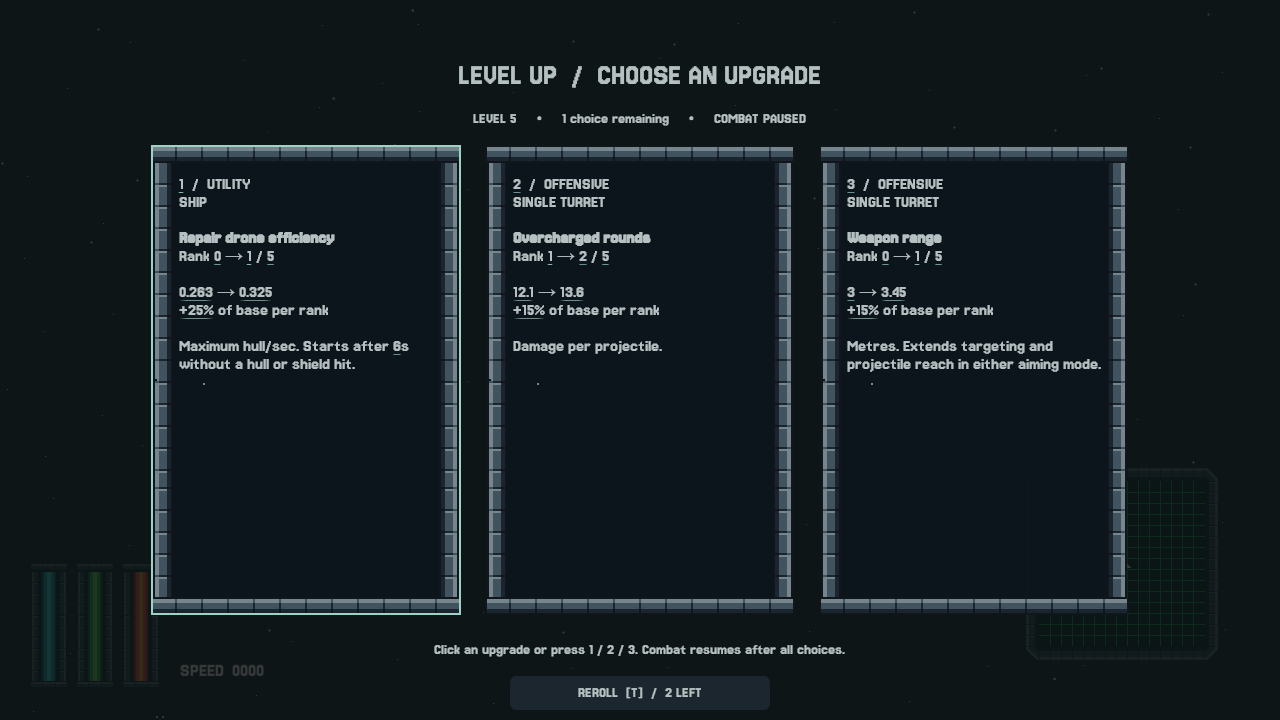
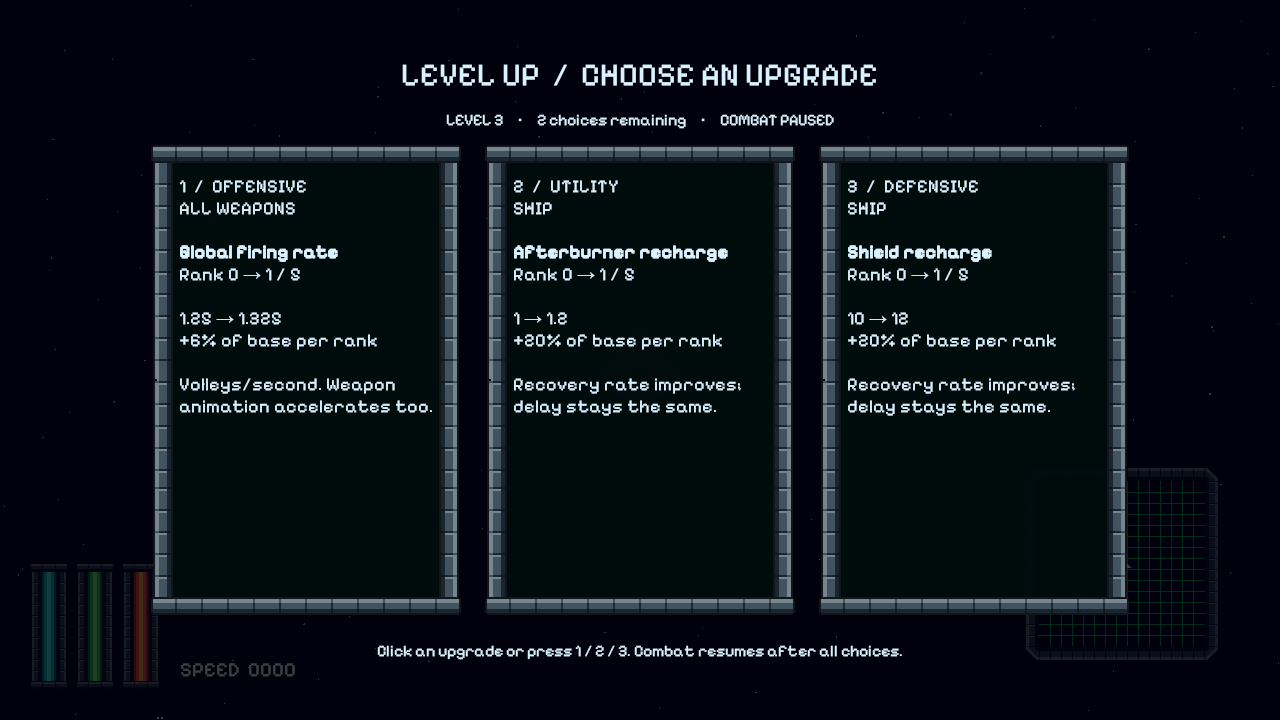
Automatic spawning, experience and credits then replaced the need to manually create every fight. Level-ups pause the simulation and offer up to three temporary upgrades, allowing a build to develop during play. Queued level-ups, finite upgrade ranks and clean restart behavior mattered here: a run should end without leaving its enemies or temporary bonuses in the next one.
A saved level-up test. Combat pauses while the player compares temporary offensive, defensive and utility options.
05 / Close the loop with a real destination
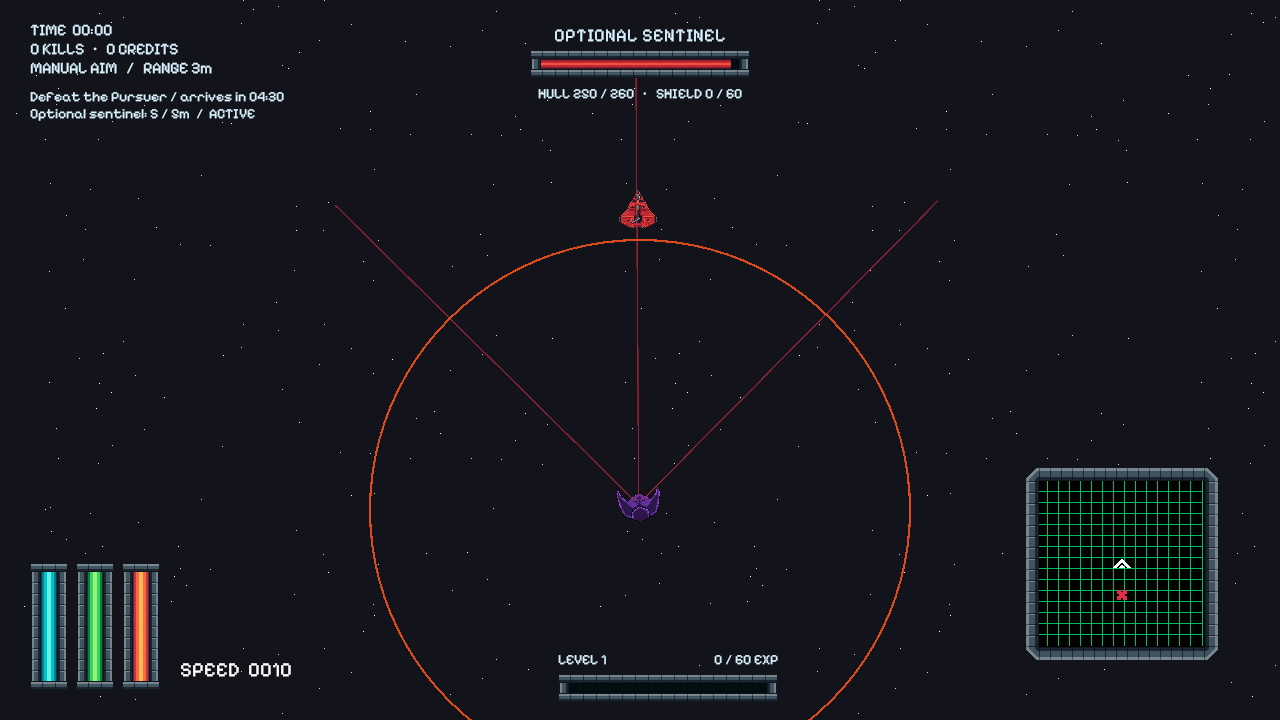
The test area added an optional stationary Sentinel and a pursuing boss. The Sentinel waits until approached or attacked, giving the player a choice about when to take the risk. The major boss arrives on a timer, brings a warning before it appears, and must be defeated to finish the area.
Victory and defeat now lead into results and a hangar, with earned credits retained and temporary upgrades cleared. Saved progression means another launch can start from the same long-term ship development rather than from a blank profile.
This is still the compact test version: one optional miniboss and one timed major boss. The plan for two to four miniboss sites and around five major bosses belongs to the larger area design, not the current feature list.
A Sentinel encounter test showing the activation area and committed attack lanes. Bosses currently reuse the Fanner model while dedicated boss artwork is still to come.
06 / A few enemy families, with room to combine them
The enemy direction became a small set of recognizable families rather than a collection of unrelated attacks. Small units teach individual patterns; minibosses can combine one or two of them; major bosses can eventually combine more patterns and add their own special behavior.
The Gunner and Fanner received distinct ship sprites instead of separate turret models. Their bullets now leave the visible weapon outlets: one shot for the Gunner and three in the Fanner spread. Aligning those origins was important because the artwork should explain the attack.
Ordinary units no longer carry shields, and their collision shapes follow their hull artwork more closely. Enemy shots can pass through each other and friendly enemy ships, keeping a formation from accidentally cancelling its own attacks. Solid world obstacles are a separate future consideration.
07 / Let automatic fire put the focus back on flying
A later change made automatic aiming and firing the default. The turret tracks eligible enemies within weapon range, prioritizing active bosses. Dormant optional bosses are left alone, so the player can still decide when to begin that encounter.
Manual aiming remains a saved hangar option. Weapon range also became a meaningful upgrade because it changes when an automatic turret can acquire and engage a target. Early tuning brought the starting range down and slowed the starting fire rate to leave more room for movement and progression.
The starting weapon is now a Single turret. The Double turret moved out of the temporary level-up pool and into permanent research and equipment choices. That gives future weapons a clearer place to live.
08 / Build a hangar with three different jobs
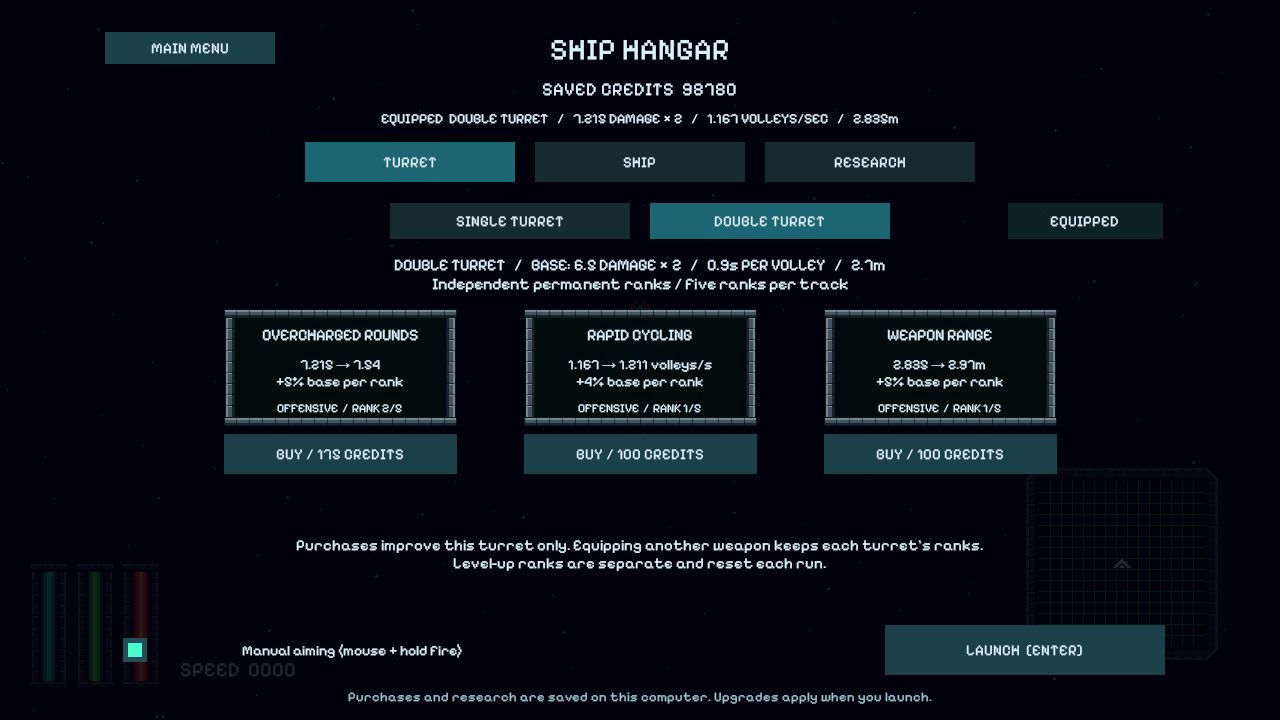
The hangar is organized into Turret, Ship and Research. Turret upgrades belong to one weapon: Overcharged rounds, Rapid cycling and Range. Single and Double keep their own ranks, so investing in one weapon does not silently improve every future turret.
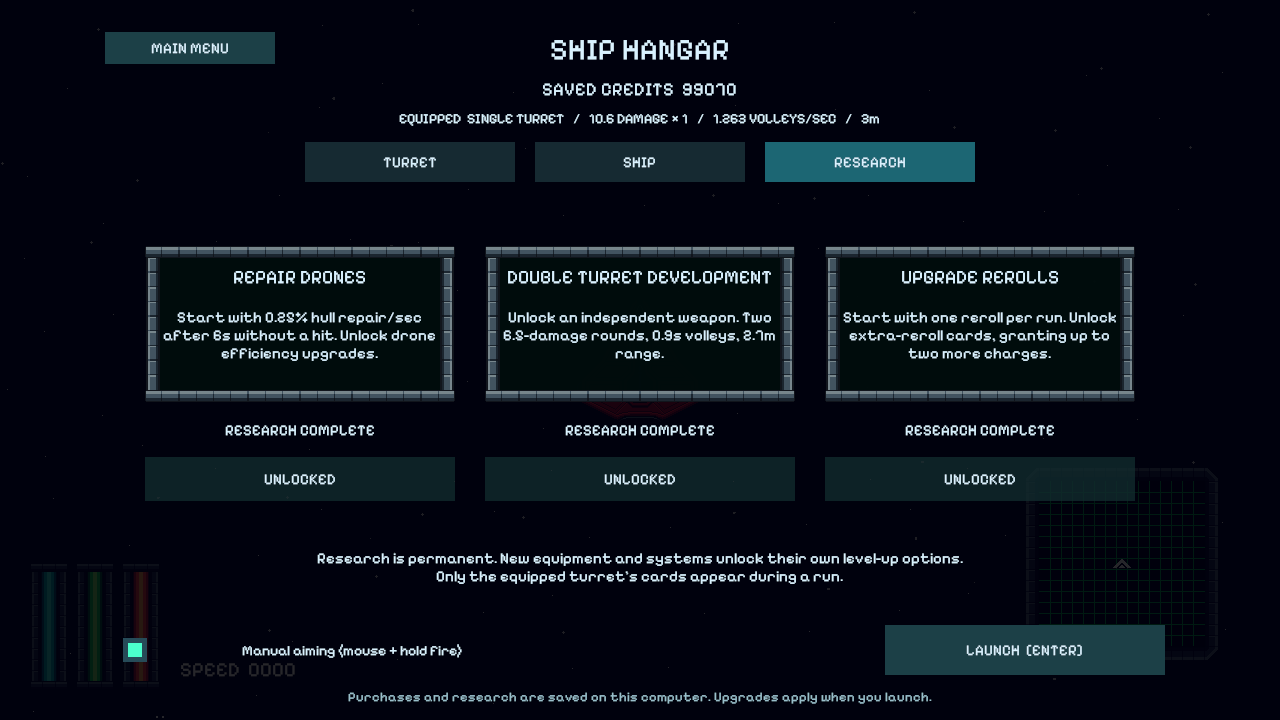
Ship upgrades provide smaller global improvements to damage, firing rate, hull, shields, recharge, afterburner reserve and recovery. Research makes the bigger steps: unlock the Double turret, start runs with conditional repair drones, or gain upgrade rerolls. Repair efficiency becomes available after its research is unlocked.
The same unlocked systems can then offer temporary improvements during a run. Only the equipped weapon contributes its specific cards; locked research does not dilute the choices. Permanent and temporary ranks are separate, and percentage gains add against the base values to keep their effects understandable.
These are starting balance values, not a finished economy. The point is to make permanent investment useful while keeping a single run flexible and the ability to dodge important.
Weapon-specific permanent progression in the Double turret tab. The large wallet is a test fixture, not normal starting progress.The three initial research unlocks. This verification capture deliberately shows all three completed.
09 / Add the Bombardier: danger can start somewhere else
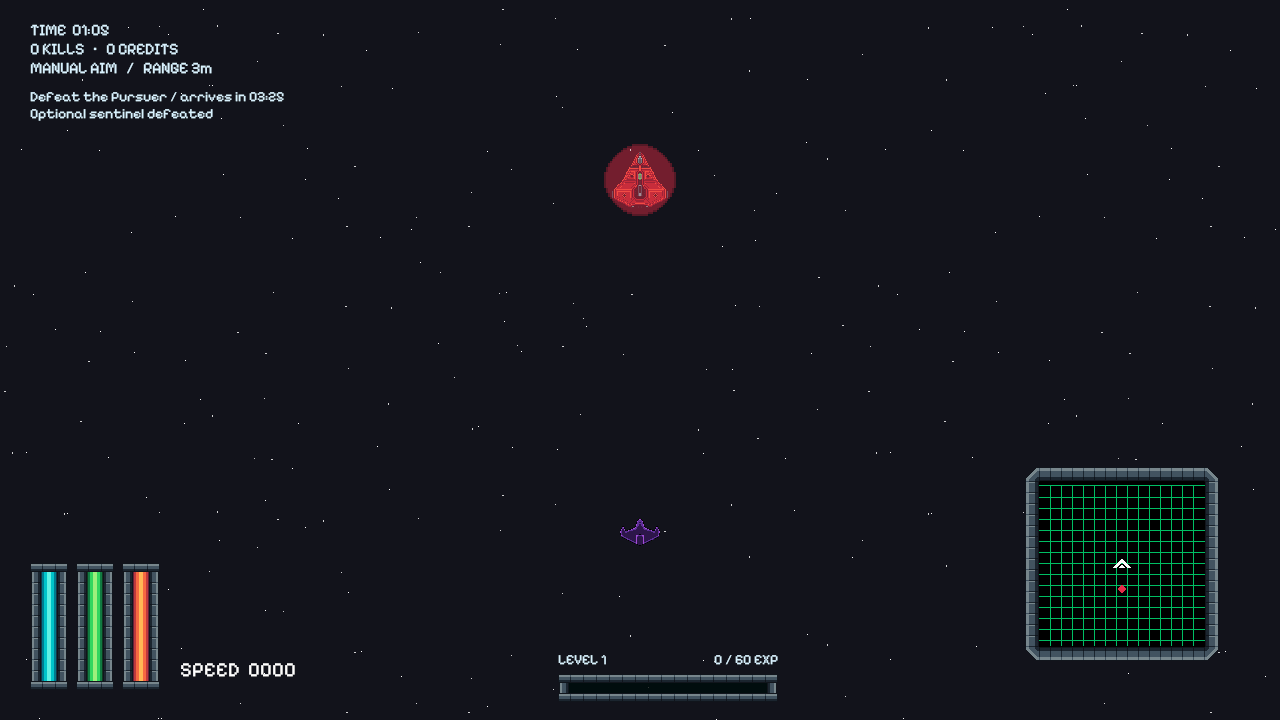
The Bombardier tests a different kind of movement. It selects a location, shows an animated warning circle, then releases an outward ring of bullets from that marked area. The position stays fixed after the warning begins, so the player has time to leave it rather than being chased by a marker.
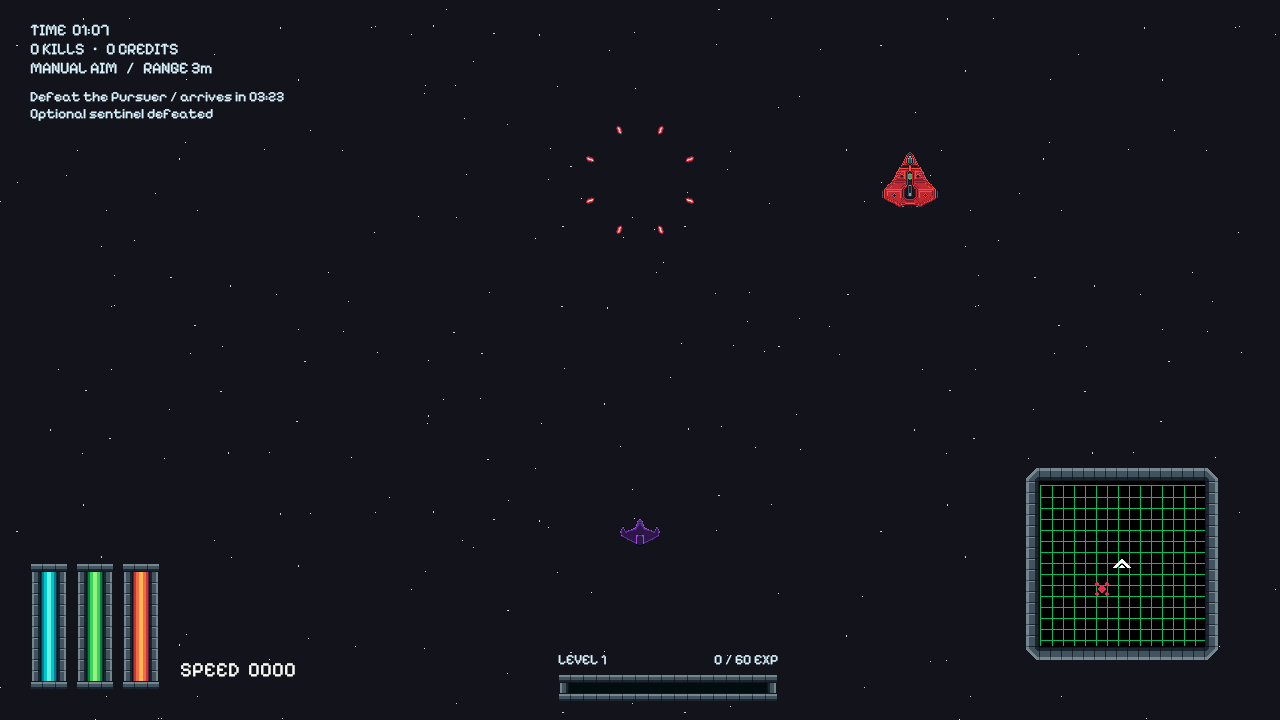
The current eruption has eight outward shots. Killing the unit before it releases the attack cancels the warning, while bullets already in flight remain a threat. The spawn mix limits Bombardiers so that learning the pattern does not immediately mean managing a screen full of overlapping circles.
The warning circle was also reduced to half its original diameter after testing. That sort of adjustment matters to the experiment: the warning needs to be readable and useful without visually swallowing the ship or the fight.
Bombardier verification, before release: the warning commits to a location.The same attack after release: the player has moved clear and the bullets spread from the original position.
10 / Make the game easier to enter and read
The UI has been its own series of experiments. An early nine-slice frame led to trying tiled edges, then to purpose-made pixel-art bars and cards. Temporary upgrades use tall cards; hangar upgrades use horizontal ones. Experience sits at the bottom, run information at the upper left, and boss names and health amounts sit outside a smaller health bar.
New hostile radar blips distinguish regular units from bosses, and animated warning lines and circles tie enemy attacks into the artwork. Unnecessary button frames were removed, the death screen gained a card layout, and the scene lost its old white test rectangle and starting-point circle. The optional boss encounter ring remains useful.
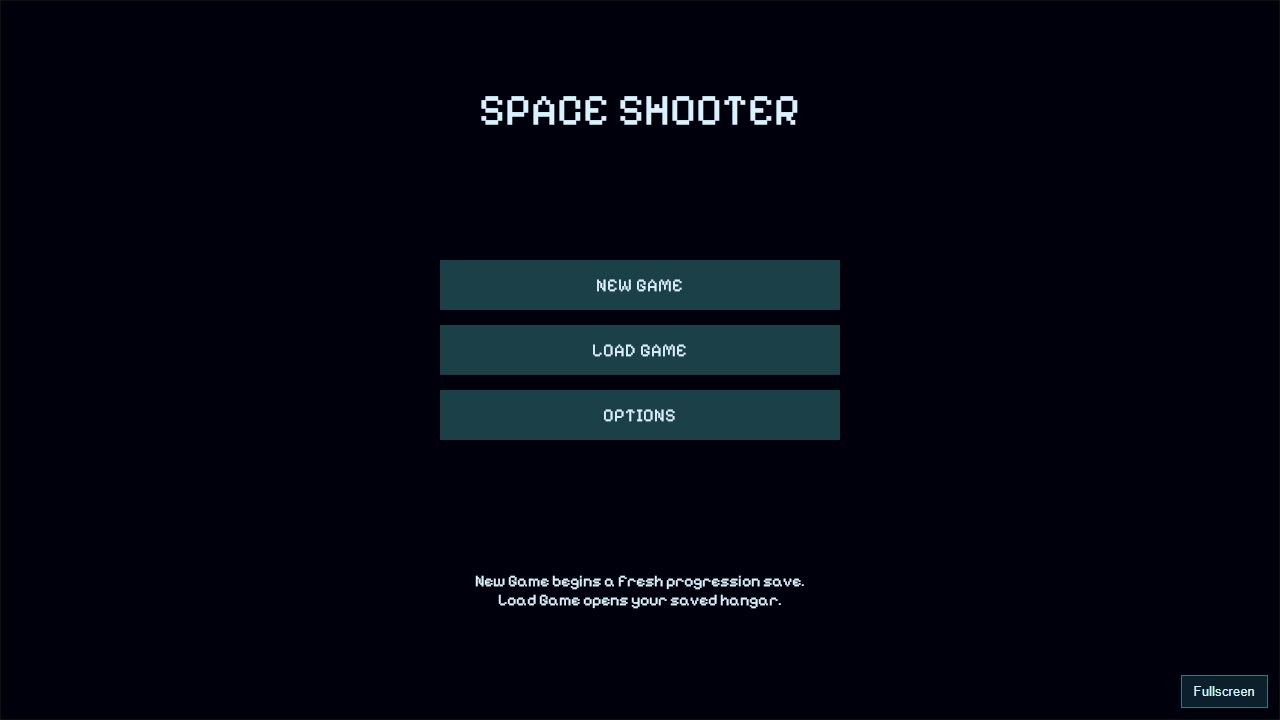
A main menu now offers New Game, Load Game and Options, with Exit Game in the desktop version. New Game waits for the instruction “Move to start round”; Load Game opens the saved hangar. Pause lets the player inspect active temporary upgrades, change options, end the round or quit where the platform supports it. The browser version returns to the main menu instead of trying to close the tab.
11 / Publish the experiment where people can try it
Getting the website online changed the prototype from something opened inside Unity into something shareable with a link. Web Build Support, a loading page, fullscreen control and browser save persistence made the game usable on the site.
The first live release was checked for movement, combat, pause, returning to the hangar and restoring earned credits after a full page reload. The saved state belongs to that browser and site; it does not share the desktop save or provide cloud accounts.
Publishing is now connected to the game repository. A push can trigger a private Windows runner, build with the local Unity installation, update the website repository and let Vercel deploy it. The complete loop has been tested successfully. The build machine needs to stay awake and online, but routine updates no longer need a manual file upload.
The browser prototype at its main menu, captured during the first live deployment checks.
12 / The next question is whether it stays fun
There is finally a complete small loop to evaluate: launch, move, fight, level up, take a boss encounter, return with credits and improve the ship. That is a more useful milestone than having another isolated effect or menu, even though those smaller details helped make it possible.
The next work is to playtest pacing, enemy combinations, upgrade choices and the cost of permanent progression before expanding the area into the longer boss sequence. Distinctive boss art, more weapon types and a wider set of enemies should support that loop as it proves itself.
The main question is still the one the project started with: does flying this ship out of trouble feel good enough to make another run worth starting? The prototype is now on the site, and this log gives the next round of changes a place to begin.